EMT Practice Test

1. Question Content...


Question List

Question1: Excessive uplink RTP frame retransmissions can result in ____________.

Question2: In a manufacturing facility with highly reflective materials, you are planning an upgrade to your existing
802.11b WLAN implementation. You have chosen a dual-band 802.11n infrastructure product for this purpose. Your client applications include:
Handheld scanners - for inventory management

Toughbooks (laptops) - mounted on forklifts for inventory and workflow management

VoWiFi phones - used by select employees throughout the facility

You are evaluating all of the 802.11n enhancements and determining which features to enable for your environment and applications.
In this scenario, what 802.11n enhancement typically should NOT be enabled on the 2.4 GHz radio of the new APs?

Question3: What is the purpose of DHCP Option 43, and how is it used with WLANs?

Question4: Given: In a site survey deliverable report, you are expected to explain the spectrum measurements taken at the customer's site. What portion of a spectrum analyzer view can be used to determine if a given channel is too active for use as the active channel for a new AP?

Question5: When preparing a floor plan graphic for use in predictive and manual site surveying, what calibration method will lead to the most accurate and reliable RF data?

Question6: Of the following antenna connector types, which one is the smallest?

Question7: What VoWiFi implementations frequently require multicast packet delivery support by the WLAN infrastructure?

Question8: Assume that your network operates in a regulatory domain that allows use of the entire 5 GHz space allowed in the 802.11ac amendment. In your upcoming 802.11ac deployment, you would like to take advantage of the performance improvements that result from channel bonding. However, after extensive testing, you have determined that your mission-critical WLAN should not use channels requiring DFS support.
Given those two criteria (enable channel bonding and disable DFS channels), in the 5 GHz spectrum, how many non-overlapping 40 MHz channels will your system be able to use?

Question9: In a multiple channel architecture (MCA) network supporting 802.1X authentication, what aspect of WLAN design affects client roaming efficiency and effectiveness?

Question10: In a PC-based spectrum analyzer, what data chart identifies the overall RF utilization of a specific frequency in the environment being surveyed?

Question11: What is a radome?

Question12: When live video streaming solutions that transmit simultaneously to more than one recipient are used, what special capability should be considered and configured in all affected WLAN implementations?

Question13: You have determined the best mounting locations for APs in a given installation. The facilities manager has asked you to change the locations for several APs due to aesthetic concerns. You suggest mounting the APs in the ideal locations and painting them so they go unnoticed in the environment.
What is a valid recommendation or consideration when painting APs?

Question14: You are selecting external antennas for use in a bridge link deployment. What chart should you request from the antenna vendors to make an accurate selection?

Question15: What action should be taken after implementing a WLAN based on the design developed from the site survey process?

Question16: You are on site, planning a network at a freight shipping company on a busy harbor. Since the preliminary WLAN design specifies support for the 5 GHz spectrum, you would like to test for radar pulses to determine if DFS channels should be supported at this facility. As a part of your spectral survey with a laptop-based analyzer, you include DFS testing to identify the presence of radar. This is done by manually observing Real-time FFT, Duty Cycle, and Active Devices charts of the spectrum analyzer software.
What potential drawback is present with this DFS test method?

Question17: ABC Manufacturing has a heavily-used dual-band (2.4 / 5 GHz) WLAN, but sporadic RF interference across the 2.4 GHz band is causing dropped VoWiFi calls and leading to data connectivity and throughput problems.
In addition to avoiding 2.4 GHz channels and installing a distributed spectrum analyzer to locate RF interference sources, what should the implementer do to resolve the problem fully?

Question18: When a WLAN controller sends an 802.11 frame to a lightweight AP for transmission on the wireless medium, how does it mark the frame for 802.11 QoS priority?

Question19: ABC Company has a WLAN controller with 10 controller-based APs; the Voice SSID is configured for centralized data forwarding. Each AP is connected to an access port on a layer-2 Ethernet switch. Each layer-2 switch is uplinked to a single layer-3 core Ethernet switch. The WLAN controller is connected directly to the layer-3 core Ethernet switch. Layer-3 tunnels are created between all controller-based APs and the WLAN controller. A voice server is connected to the layer-3 Ethernet switch.
When a voice-enabled QoS STA sends an IP data packet to a voice server in this scenario, the DSCP value carried in the STA's IP data packet gets mapped to what and by which device?

Question20: Given: The 802.11ac APs you have selected for your public access deployment support many of the PHY and MAC enhancements offered by the 802.11n and 802.11ac amendments. The AP is configured for a single-band (2.4 GHz) and only allows 20 MHz channels. The WLAN radio in the AP is a 3x3 802.11n chip that supports two spatial streams.
What is the maximum MCS rate that could be supported by this AP?

Question21: You are tasked with designing the WLAN to accommodate certain high density areas on your university campus where users frequently come and go. With a limited DHCP pool size (subnet mask
255.255.252.0) for this WLAN subnet, you want to ensure that your DHCP addresses are used efficiently and are not exhausted, which would prevent new client Layer 3 connections. The DHCP server is a Windows Server 2012 R2 machine. Your design task is to determine the best configuration to allow as many users as possible while avoiding WLAN service interruptions and also to use the available addresses as efficiently as possible.
What setting would be most effective at achieving this design task?

Question22: A wireless engineer from your company performed a site survey in an office building where a wireless network extension was needed. He reports that while performing a Layer 1 sweep near a meeting room full of people, he detected RF activity with a very low duty cycle. He is unsure how to interpret what he recorded to determine its impact on a future Wi-Fi network.
What is true about this RF environment and its potential impact on the WLAN?

Question23: While configuring your site survey software for an upcoming manual survey project, you notice the configuration option for "Network Card Simulation". What is the purpose of such a feature and when would you use it?

Question24: What are some advantages of designing guest access with all guest users tunneled directly into the DMZ?

Question25: Which one of the following is an essential metric to measure when performing a survey and design for VoIP across WLANs?

Question26: As an implementation engineer, you have just received initial design specs from a network designer for your dual-band 802.11n deployment. The network design documents prescribe the following data rate configuration for the 2.4 GHz radio:
Basic Rates - 5.5, 6, 11, 12 Mbps
Supported Rates - 9, 18, 24, 36, 48, and 54 Mbps as well as MCS 0-15
What will result from this design strategy?

Question27: Given:
In your regulatory domain, a Tx Power Level of "1" is equivalent to 17 dBm.
For every integer increment (e.g. from 1 to 2) to the Tx Power Level, the AP's transmit power is halved.
In units of mW, what is the actual transmit power for an AP configured at a Tx Power Level of "4"?

Question28: You are testing a VoWLAN deployment, and your communication measurements show a certain amount of lost packets. What would be an acceptable packet error rate value to still provide acceptable call quality?

Question29: When implementing WLAN security according to common best practices, what feature should be enabled when configuring an EAP type?

Question30: When you see the SKINNY protocol in a post-install validation protocol capture, what does this indicate?

Question31: Given: A WLAN controller is connected to ABC Company's core layer 3 Ethernet switch with an IEEE
802.1Q trunk connection. The WLAN controller's native VLAN is VLAN 6 and its IP address is
10.0.14.2 /24. Lightweight APs supporting centralized forwarding are connected to the network on VLANs
7, 8, and 9, and they each build a Layer 3 tunnel back to the WLAN controller's IP address.
The dynamically assigned IP addresses received by each AP from a DHCP server will be
________________.

Question32: What is a valid 40 MHz channel configuration in the 2.4 GHz ISM band where channels 1-11 are permitted?

Question33: In a large enterprise (5000+ wireless users), by what would NOT be a recommended method by which IP addresses and VLANs are assigned to different clients associated to the same AP?

Question34: When deploying long-distance 802.11 bridge links (10 miles / 16 km), what parameter may be critical for improving data flow by reducing retries caused by the long distances?

Question35: As you plan a WLAN upgrade, you have assessed the network requirements and data signatures of your applications. One of the popular applications used on your network requires high bandwidth and low to medium Wi-Fi loss, but can tolerate moderate latency and jitter.
What application matches this description?

Question36: When selecting a centralized WLAN architecture, what new problem may arise when you change the data forwarding model from centralized to distributed?

Question37: You are creating an outdoor bridge link that spans more than 1000 yards. Which one of the following antenna types is more likely to be included in the design?

Question38: Which definition correctly describes the "local MAC" variation of the centralized WLAN architecture?

Question39: What kind of antenna results in a nearly circular pattern on the azimuth chart but a very flat donut shape on the elevation chart?

Question40: Why does a frame transmitted at 1 Mbps have a greater usable range than the same frame transmitted at
54 Mbps?

Question41: You deployed an AP and installed its antenna, and you now need to set the AP transmit power. Given a desired EIRP of 21 dBm, and an antenna gain of 5.85 dBd connected through 25 feet of cable with a loss specification of 4 dB/100 feet.
Assuming that there is no significant loss from the connectors, what should be the transmit power level for this AP?

Question42: An associated STA detects a new BSS with the same SSID as the STA's current BSS. The new BSS uses a different IP subnet than the current BSS. If the STA is configured to use 802.1X/EAP preauthentication, what is likely to occur?

Question43: One of your customers plans on providing wireless coverage to a warehouse facility. After performing an initial walkthrough, you collect the following information:
The central part of the warehouse is between 400 and 600 feet (122 to 183 meters) from the

warehouse switches mounted on the walls.
The warehouse storage is composed of metallic racks with varying inventory levels and contents, from

electronics and plastic toys to food pallets and juice bottles.
Workers need basic data coverage from their working location, and are not highly mobile. They usually

work from one single aisle, and their laptop is on a cart with wheels.
What would be your one recommendation to provide coverage to the central area of the warehouse?

Question44: What is the meaning of a Real Time FFT graph?

Question45: When performing an indoor predictive site survey to make the WLAN planning and design cycle more efficient, what is a best practice for configuration of the simulated APs in the predictive modeling software?

Question46: At a university, the WLAN has been successfully deployed for ubiquitous access for faculty, students, and guests. Many student computer labs are available throughout the campus with wired network connectivity, but there are also a few smaller lab areas and workstations where Ethernet cabling is not available. For student wireless use, the students must authenticate against RADIUS/Active Directory using PEAP. Also, the network administrators at this university would like administrative access to these workstations when they are not in use by students so that the administrators can manage group policies, update OS patches, and perform other routine software maintenance.
What deployment option is available and recommended for both student use and remote administration of these workstations?

Question47: You desire to achieve a 450 Mbps MCS. What 802.11n features (from the numbered list below) are required?
1. Frame aggregation
2. Short GI
3. 40 MHz channels
4. 2 spatial streams
5. 3 spatial streams
6. Transmit beamforming (TxBF)

Question48: In this question, you will compare the mobility processes of a network that supports WPA2-Personal and WPA2-Enterprise. Assume the use of a 15-character ASCII passphrase for WPA2-Personal and EAP- TTLS/MSCHAPv2 with WPA2-Enterprise. Also, assume that proprietary roaming protocols are not supported.
When a device transitions from one BSS to another within the same ESS, what step must be performed in the WPA2-Enterprise transition that are not performed in the WPA2-Personal transition?

Question49: You are site surveying a network for VoWiFi. You have positioned an AP for a manual survey and are moving away from the AP with a phone in Survey Mode in your hand and you are reading the RSSI value of the signal received from the AP. You have previously determined that the noise floor was approximately
-94 dBm on this floor of the building. The phone's documentation does not specify a recommended RSSI or SNR value for best performance.
Based on the information provided and the type of device (VoWiFi phone) you are deploying, what minimum RSSI should you plan for in all areas you are monitoring and where VoWiFi service is desired?

Question50: What commonly causes a client-to-AP link imbalance?
Question51: What is the DSCP Per Hop Behavior equivalent classification of the 802.11 AC_VO priority level?

Question52: Given: For this fill-in the blank question, each answer option contains an answer for the first and second blanks, separated by a dash "-". Choose the answer option that correctly fills in both blanks in the following sentence.
A WLAN may use 802.11 admission control to ________, and admission control requirements are configured separately for each ________.

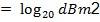
Question53: What basic RF math formula should be used as a baseline to convert an RF value in units of dBm into a value of mW?
*Note: "dBm" in the formulas represents the known dBm value
A: 0 dBm = 1 mW
B: mW
C:

D: mW

mW

Question54: What is the purpose of Friis transmission equation [ (LdB) = 20 log(d) + 20 log (f) - 27.55 ]?

Question55: What statement is true of a WLAN design that supports Real-Time Location Services (RTLS) with 802.11 RFID asset tags?

Question56: Given: You are evaluating the theoretical and real-world RF gain benefits of transmit and receive features introduced by 802.11 with MIMO. This exercise allows you to quantify the feature's value in a real-world environment.
What is the maximum theoretical signal gain of chip-based TxBF and MRC (as features) when compared to the same AP using only a single antenna for transmit and receive (effectively simulating a 1x1 chip)?

Question57: You are working on a VoWLAN design with your customer's wired networking team. How many distinct priority levels do you expect for the voice applications?

Question58: Given: As the wireless network administrator for XYZ Company, you are planning to upgrade your aging wireless network infrastructure, as well as some clients, to support 802.11ac. In your research, you have discovered that your new wireless client devices and infrastructure are 802.11ac, WMM, and WMM-PS certified by the Wi-Fi Alliance. Some of your existing client devices are 802.11a/b/g devices that do not support WMM.
Given this information, what scenario is possible when your company's employees begin using both types of client devices on the new WLAN?

Question59: During a post-deployment verification, you are requested to troubleshoot an area where users are experiencing poor throughput. They are using data communication only, mainly from laptops. You captured the frame showing an incorrect FCS. This frame is typical of those that were captured by the analyzer.
What does this frame reveal about the RF network in this area?

Question60: You told your customer that multipath fading may be mitigated simply by moving one or both of the receiver's antennas a small amount, usually by one to four wavelengths away from its original position.
Your customer is prepared to make the change, but does not know the wavelength for 802.11ac.
What is the approximate wavelength of an 802.11ac radio wave?
